
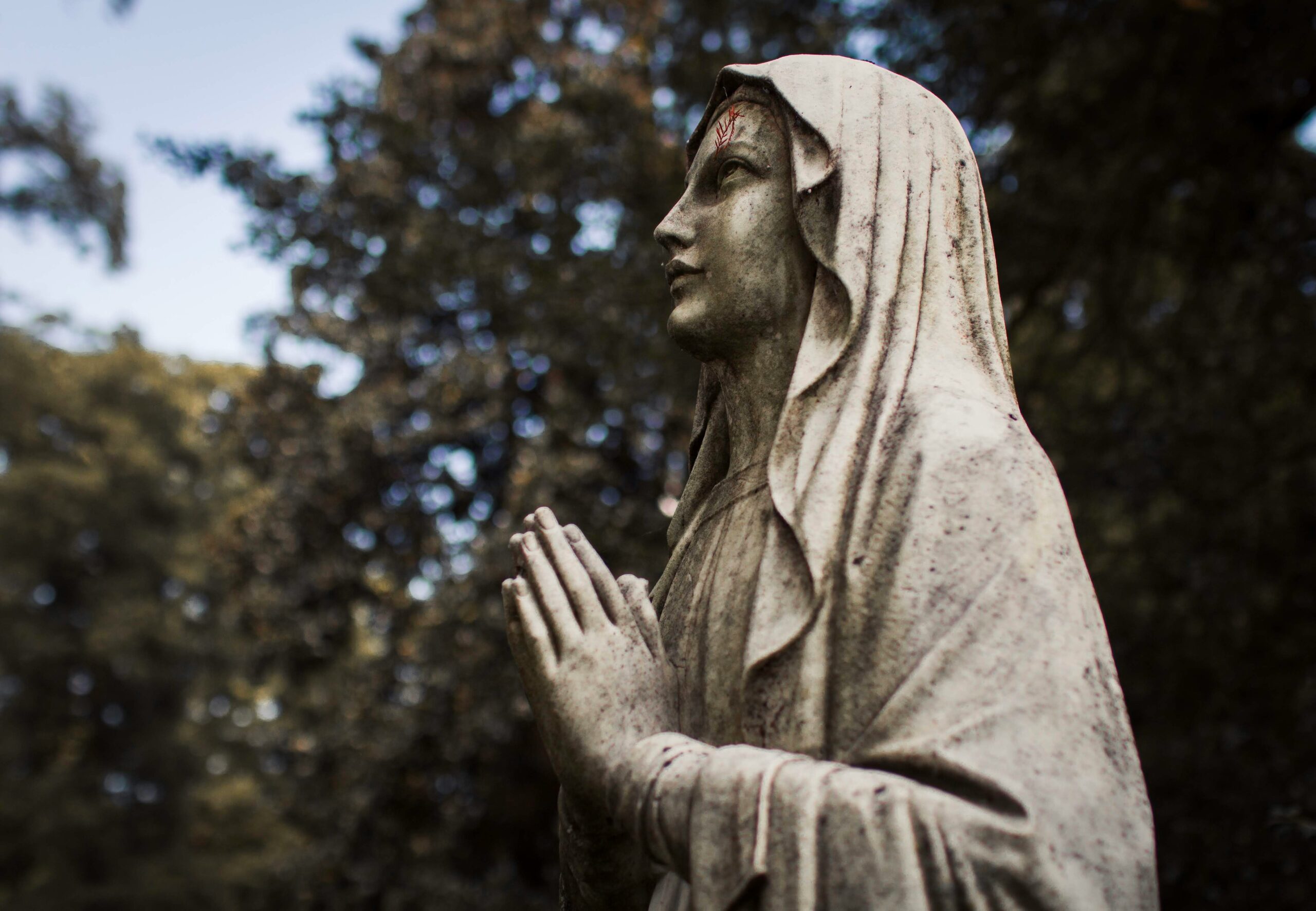
Photo by Darrien Staton on Unsplash
For centuries, Mary—the mother of Jesus—has been cast into the role of the silent, obedient, and sanctified woman. She is remembered less as a human being and more as a symbol of purity, sacrifice, and maternal devotion. But Colm Tóibín’s The Testament of Mary disrupts this tradition by granting Mary her own voice, one unfiltered by church fathers or patriarchal doctrine. What emerges is a startling, deeply human portrait of a woman consumed by grief, disillusionment, and anger.
From a feminist perspective, The Testament of Mary can be read as an act of reclamation. Tóibín strips away centuries of religious iconography to ask: what happens when Mary is no longer the quiet vessel of divine will, but instead a woman who questions, resists, and mourns?
Mary Against the Narrative
In the novel, Mary does not glorify the crucifixion. Instead, she describes it as unbearable violence that no theological justification can redeem. “I did not think that the cursed shadow of what had happened would ever lift,” she admits. Unlike the gospel writers, she refuses to reframe her suffering as noble or redemptive. Here, feminist theory on women’s silenced grief resonates—Mary’s refusal to beautify her pain pushes back against the patriarchal expectation that women’s suffering must always serve a higher purpose.
A Mother, Not a Symbol
Feminist theologians such as Elisabeth Schüssler Fiorenza have argued that early Christianity depended on women’s labor, voices, and stories—yet those same women were written out of the official canon. Tóibín’s Mary is an imagined restoration of that missing voice. She is not “The Blessed Virgin,” but a mother who loved her son, feared for him, and resented the men who followed him. When she recalls the disciples’ arrogance and blindness, her skepticism mirrors feminist critiques of male-dominated religious authority: women are expected to endure while men claim divine truth.
The Politics of Silence
One of the most haunting aspects of the book is Mary’s silence. She acknowledges that her story has been reshaped, controlled, and re-told by others. In this, Tóibín points toward a broader feminist concern: who gets to write history? Just as Draupadi’s story in the Mahabharata has been re-read through feminist lenses to recover her agency, Mary’s silence is an invitation to imagine how women’s voices have been consistently suppressed in religious traditions.
Beyond Obedience
By refusing to depict Mary as obedient or sanctified, The Testament of Mary challenges the archetype of the “ideal woman” in Christian history. Instead of embodying the Virgin Mother stereotype, Tóibín’s Mary embodies what Audre Lorde called the power of anger—anger as clarity, as survival, as resistance. Her grief is political, because it refuses to be transformed into doctrine.
Why This Matters Today
Re-reading biblical women through feminist eyes matters because these archetypes still shape how women are treated. The expectation that women must be self-sacrificing, pure, and endlessly forgiving traces directly back to figures like Mary as constructed by patriarchal theology. Tóibín’s novel reminds us that behind every symbol is a human being—complex, flawed, and real.
By giving Mary her own testament, Tóibín opens the door to feminist reinterpretation of sacred texts, reminding us that scripture is not neutral—it is political, gendered, and often silencing. Feminist analysis makes visible what has been erased: that women’s voices have always been there, waiting to be heard.
Leave a Reply